
Web development continues to evolve rapidly, driven by technological advancements and the growing demand for seamless digital experiences. As we move into 2025 and 2026, web developers need to go beyond just writing HTML and CSS. Companies are looking for professionals who can build modern, scalable, and intelligent web applications. Whether you’re starting out or aiming to become a full-stack web developer, mastering the right skills is key.
In this post, we’ll explore the top 10 web developer skills for 2025 and 2026 and provide a practical roadmap to becoming a full-stack web developer.
🔟 Top Web Developer Skills for 2025 and 2026
👨💻 Key Skills for a Successful Web Developer
1. JavaScript Mastery (and TypeScript)
JavaScript remains the backbone of web development. But in 2025, simply knowing JS isn’t enough. A deep understanding of ES6+ features (like async/await, destructuring, and modules) is a must. Additionally, TypeScript—a statically typed superset of JavaScript—is becoming a standard for large-scale applications.
Why it’s important:
- Improves the maintainability of codebases.
- Widely used in modern frameworks like Angular, Next.js, and NestJS.
2. Modern Front-End Frameworks (React, Vue, Svelte, SolidJS)
React still dominates the landscape, but frameworks like Vue 3, Svelte, and SolidJS are gaining popularity due to performance and developer experience.
Key skills:
- Component-based architecture
- State management (Redux, Pinia, Zustand)
- Server-side rendering (Next.js, Nuxt)
3. Back-End Development (Node.js, Python, Go)
The ability to build server-side logic is what separates a full-stack developer from a front-end specialist. In 2025, Node.js remains a solid choice, but developers are also exploring Go and Python for their performance and simplicity.
Key tools:
- Express, Fastify (Node.js)
- Django, FastAPI (Python)
- Gin, Fiber (Go)
4. APIs and GraphQL
Knowing how to work with APIs (especially REST and GraphQL) is essential. GraphQL is especially growing in enterprise environments due to its efficiency in querying data.
Bonus tip: Learn how to create, consume, and secure APIs using JWT, OAuth2, etc.
5. DevOps and Deployment (CI/CD, Docker, Vercel, Netlify)
You can’t be a modern developer without understanding how to deploy your app. Platforms like Vercel, Netlify, Render, and AWS Amplify make this easier than ever.
Skills to learn:
- Docker basics
- CI/CD workflows (GitHub Actions, GitLab CI)
- Basic server management (NGINX, PM2)
6. Version Control with Git & GitHub
Still as relevant as ever, Git is the industry standard for version control. Learn advanced workflows like:
- Feature branching
- Rebasing
- Pull request reviews
Also, Contribute to open source to build your GitHub profile.
7. Web Performance Optimization
In 2025, performance = ranking. With Google’s Core Web Vitals affecting SEO, knowing how to optimize front-end performance is a must.
Key areas:
- Lazy loading
- Code splitting
- Caching strategies
- Lighthouse audits
8. AI Integration & Prompt Engineering
AI is not a separate domain anymore—it’s becoming embedded in web development workflows. From building chatbots to integrating recommendation systems, developers who understand AI APIs (OpenAI, Google Gemini, etc.) will have a big edge.
Learn about:
- Prompt engineering
- AI SDKs and APIs
- Responsible AI usage (ethics, privacy)
9. Database Management (SQL & NoSQL)
Choosing the right database is crucial for application performance. Developers must be fluent in both relational (PostgreSQL, MySQL) and non-relational (MongoDB, Firebase) databases.
Bonus: Learn ORMs like Prisma (Node.js), Sequelize, or SQLAlchemy (Python).
10. Soft Skills: Communication, Collaboration, and Problem Solving
Technical knowledge is important, but real-world success depends on your ability to work with teams, communicate ideas, and think critically.
Soft skills that matter:
- Code documentation
- Agile collaboration (Scrum, Kanban)
- Time management and self-learning
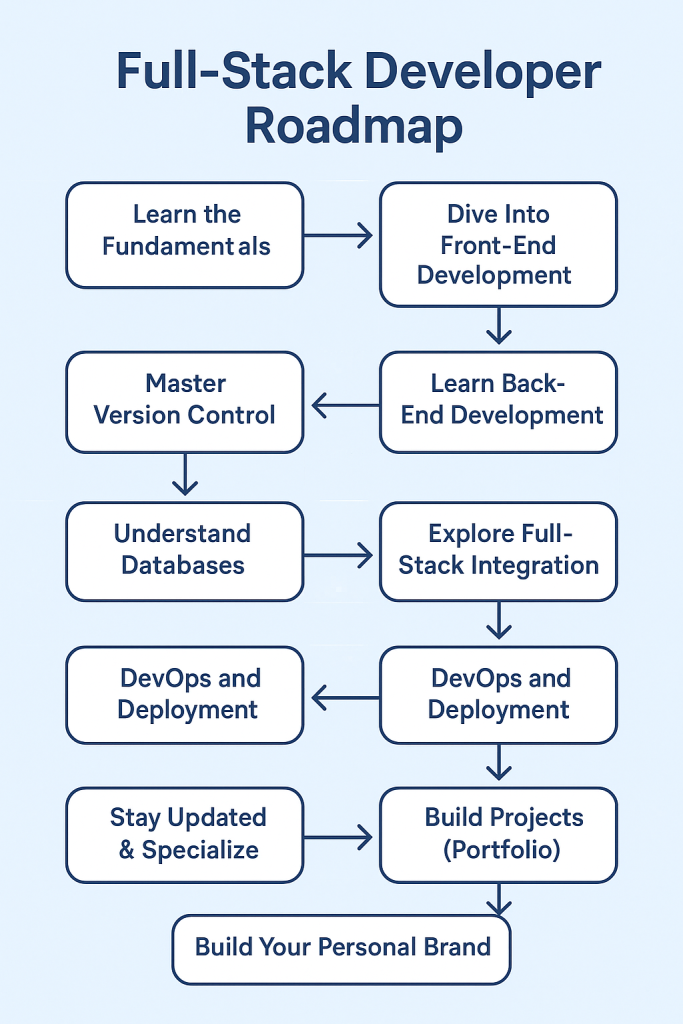
🎯 Roadmap to Becoming a Full-Stack Web Developer (2025–2026 Edition)
Here’s a step-by-step guide for mastering full-stack web development:
📌 Step 1: Learn the Fundamentals
- HTML5: Semantic elements, accessibility
- CSS3: Flexbox, Grid, media queries, responsive design
- JavaScript (ES6+): DOM manipulation, event handling, fetch API
🛠 Tools: CodePen, JSFiddle, GitHub
📌 Step 2: Dive Into Front-End Development
- Choose a framework: React (preferred), Vue, or Svelte
- Learn component-based development, props/state, hooks (for React)
- Responsive design using Tailwind CSS, Bootstrap, or Material UI
📚 Concepts:
- SPA (Single Page Applications)
- Routing (React Router, Vue Router)
📌 Step 3: Master Version Control
- Learn Git (clone, commit, branch, merge)
- Understand GitHub workflows: PRs, issues, forks
- Try contributing to open source
📌 Step 4: Learn Back-End Development
- Pick a language: JavaScript (Node.js), Python, or Go
- Set up a server using Express.js, FastAPI, or Fiber
- Connect to a database (PostgreSQL, MongoDB)
📚 Concepts:
- REST APIs
- Authentication (JWT, OAuth)
- MVC architecture
📌 Step 5: Understand Databases
- SQL: JOINs, indexing, normalization
- NoSQL: Document stores, denormalization
- Learn basic CRUD operations and advanced queries
📌 Step 6: Explore Full-Stack Integration
- Connect front-end and back-end using APIs
- Use state management tools (Redux, Zustand)
- Implement authentication flows (login/signup)
🧪 Try full-stack templates: MERN stack, PERN stack
📌 Step 7: DevOps and Deployment
- Learn the basics of Docker, CI/CD pipelines
- Deploy apps using platforms: Vercel, Netlify, Render, or Heroku
- Understand domain names, DNS, and HTTPS
📌 Step 8: Build Projects (Portfolio)
Nothing beats learning like building.
🔨 Project Ideas:
- E-commerce app
- AI chatbot assistant
- Task manager with authentication
- Blog with markdown editor
- Real-time chat app
📌 Step 9: Stay Updated & Specialize
- Follow tech blogs, GitHub trends, and newsletters
- Choose a specialization: DevOps, AI integration, frontend UI/UX, Web3, etc.
📌 Step 10: Build Your Brand
- Create a portfolio website
- Write blog posts on Medium or Dev.to
- Share your projects on GitHub and LinkedIn
- Contribute to open-source repositories
🔚 Conclusion
The web development landscape is more dynamic than ever. Whether you’re just starting or planning to upgrade your skills, focusing on the top in-demand technologies and building real-world projects is the key to success. The demand for full-stack developers will continue to rise through 2025 and 2026, especially those who bring adaptability, efficiency, and innovation to the table.